A hero for so many, an inspiration for millions.
He'll be missed as an advocate of mutual understanding and satisfied indifference to everything we think vital.
It's a real tragedy. They don't come as he so often as others.
 "AHHHHHHHHHHHHHHHHHHHHHHHHHHHHHHHHHHHHHHHHHHHHHHHHHHHHHHHH!!!!!!!!!!!!!!!!!!!!!!"
 Some stupid fucking squid.
 "Oh FUCK! He's just CREEPING."
 Kihei, Maui, Hawaii
 lava tube, black sand beach, Hana Hwy, Maui, Hawaii
 Francis Scott Key Bridge, Georgetown, Washington, DC
 The Breakers Mansion, Newport, Rhode Island
 Rt. 36, Boulder, Colorado
 to be a part of something that poked fun at his own religion, despite a show with 150-odd episodes that has harshly lampooned every conceivable subset of global culture. This is a guy who's first album was entitled "Black Moses" and who was featured on at least one Wu-Tang CD.
But who am I to derogate another's beliefs without at least understanding them? So let's take a look.
As I am consulting Wikipedia, I have to mention that this is the third time now that I've needed to remind myself of the basic tenants of this religion; the reason for which you may understand by the end of this post.
Scientology was founded about 50 years ago, i.e. after World War II, by science fiction writer L. Ron Hubbard. Hubbard liked to write about spaceships, aliens, and the spirits of living things. Throughout his life, Hubbard stood in the shadows of good science-fiction writers like Isaac Asimov, Arthur C. Clarke, and H. G. Wells (who conceived modern space rocketry). Unlike Wells, he thought he knew what was best for everyone, so he decided to gather all the weak-minded people he could find to believe in his creation story.
[Everything in quotations below refers to Hubbard's own words]
75 million years ago, the Galactic Emperor Xenu (though Hubbard also referred to him as "Xemu" and as "Zenu," perhaps it was a typo), feeling that his Galactic Empire was vastly overpopulated (~76 planets with 178 billion people each) shuttled billions of humans to Earth on intergalactic spacecraft that were exact copies of the modern day Douglas DC-8 aircraft, "except the DC-8 had fans, propellers on it and the space plane didn't." Note that DC-8's have turbine engines, not propellers.
The pretense under which the billions of people were brought to Earth by Xen(m)u was that all of these billions were called for "income tax inspections." Upon arrival for these inspections at their local city hall, Xen(m)u had psychiatrists paralyze every single person with a combination of alcohol and glycol (antifreeze). The populace was then loaded onto the somehow-retrofitted DC-8's and transported to Earth to be stacked around volcanoes and ultimately destroyed by detonating hydrogen bombs within the volcanoes - they were all detonated simultaneously, for dramatic effect, I suppose.
I'm not sure why Xen(m)u chose a plan with such logistical headaches when he could have just send everyone into a black hole, or a star, or space itself, but I guess Hubbard was just a fucking moron.
Xenu or Xemu
Upon the calamitous explosions on Earth, the souls of the people (now called thetans) were collected by Xen(m)u using a cosmic vacuum cleaner and then place into a movie theater to watch, for 36 days, a "three-D, super colossal motion picture." Huh. Apparently this movie was pretty bad, because it implanted "various misleading data" into the memories of the thetans, "which has to do with God, the Devil, space opera, etcetera." Hubbard also states that the interior design of all movie theaters to be due to this brain-washing (though souls don't have brains). This is particularly interesting, since movie theaters have changed drastically in the 90 years popular cinema has been around. In fact, movies didn't have sound until 1927. Sigh.
Xen(m)u's cosmic vacuum was clearly stolen by Mel Brooks in Spaceballs
What happened between this pointless holocaust 75 million years ago and today is flat-out uninterpretable, due in large part to ridiculous and inconsistent naming, anachronisms, and the total lack of an understanding of how to structure and convey a story in the English language.
I should add that all of this was preceded by the creation of the Universe 4 quadrillion years ago, or 300,000 times older than the current scientific consensus. In this creation myth Hubbard describes what essentially is a generic Dark Ages painting; lots of light, a chariot, and a cherub with a trumpet.
Fuck, this is wearing me out, it's just so godamn stupid.
Strangely, the Church of Scientology denies knowing about the whole Xen(m)u thing, and refrains from speaking about it at all costs. It's either because only the top level acolytes of Scientology (called "OTVII") are ready to learn about Xen(m)u, or that this inane, nonsensical, unorganized science fiction story would embarass the Church and undermine the efforts of recruiting more idiots.
So what do Scientologists actually believe? They believe:
Sadly, the last bullet is consistent with the Church's practice, being characterized by fighting numerous extremely long and costly legal battles, and even being implicated in the death of at least one Church member.
An evil psychiatrist and her helpless, misguided patient
I'm not even halfway through the material, but I think I've made my point:
If, by now, you are not convinced that Scientology's underlying principles may qualify not as a legitimate belief structure, but only as an honorable mention 5th grade science fiction contest entry, then I suggest you contact the Church and schedule an E-meter reading.

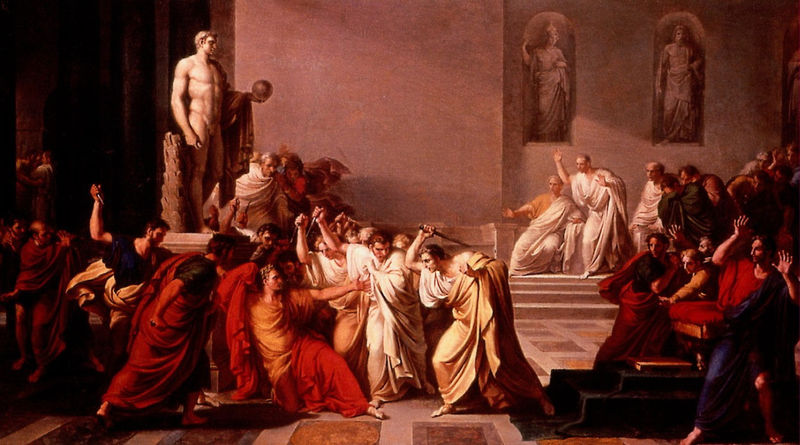
In general, Julius Caesar was a masterful military and political leader, renowned for his conquest of Gaul (modern-day France, Belgium, Switzerland) . The trouble began when he was proclaimed "Dictator Perpetuus," or Dictator for Life. This sat particularly poorly with the Roman tradition of The Republic, which split political power among numerous Senators and, to a lesser extent, influential wealthy land owners called equites. So, rather predictably, they murdered him on the floor of the Senate. He was stabbed between 26 and 35 times, depending on which account you read. One of the conspirators was Marcus Brutus, Caesar's distant cousin and a testamentary heir. Shakespeare delighted to dramatize this historic event in his play, Julius Caesar, and breathed the famous words, "Et tu Brute?" into the emperor to make them his last. Shakespeare also gave new vernacular meaning to the ides of March (ides = middle), having Caesar visit a soothsayer before his imminent death who warned him, "Beware the Ides of March!" Obviously Caesar didn't follow his advice, whether it really happened or not.
When Caesar was assassinated on March 15 in 44 BC, Gaius Octavius was studying in Apollonia, in what is now Albania. When Caesar's will was read it revealed that, having no legitimate children, he had adopted his great-nephew as his son and main heir. By virtue of his adoption Octavius assumed the name Gaius Julius Caesar, and after a series of events too melodramatic even for daytime soaps, he defeated all of his rivals by 32 BC. He established a grand empire extending from Brittania to the Persian Gulf, and successfully began an age of relative peace, known as "Pax Romana," in an otherwise bellicose empire typified by warfare both civil and imperialistic.